Contact person

Līga Ratniece-Kadeģe
Communications and Corporate Management Specialist
Tālr: (+371) 29233446 E-pasts: liga.ratniece-kadege@lsez.lv
Liepaja Special Economic Zone Authority’s 2026 Budget Focused on Development
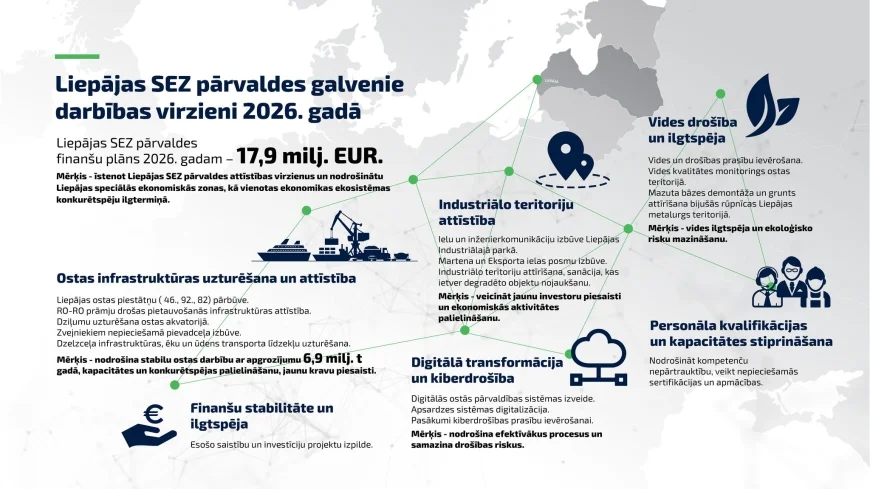
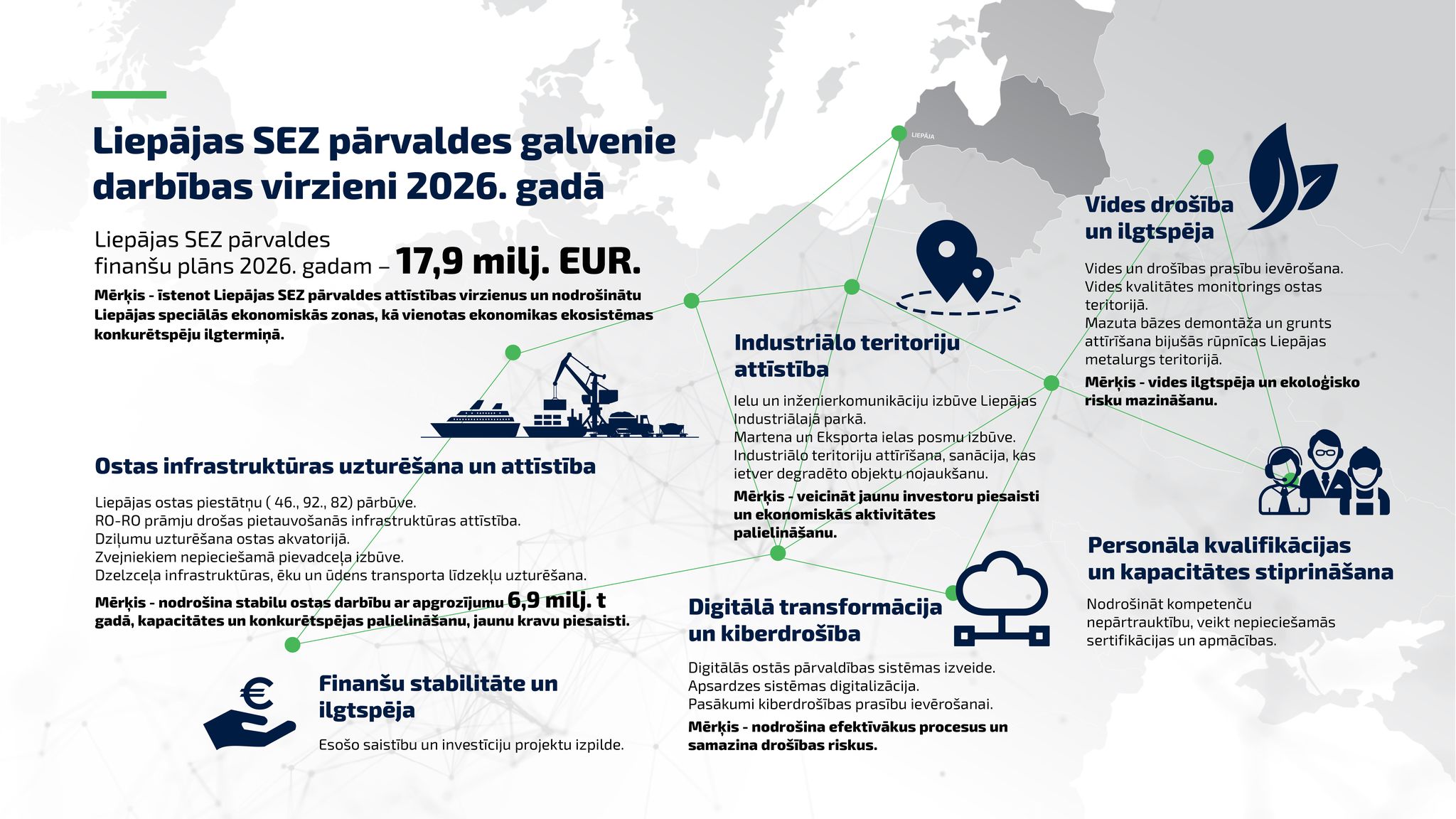
The 2026 budget of the Liepaja Special Economic Zone (SEZ) Authority has been prepared in a conservative and balanced manner, ensuring the fulfilment of core functions while continuing to implement development-oriented investment projects in the port and industrial areas. The strategic focus for 2026 is aimed at increasing operational efficiency, developing infrastructure, introducing digital port management, and improving cybersecurity. The Liepaja SEZ Board has approved of the 2026 budget with a planned turnover of EUR 17.9 million.
The Liepaja SEZ CEO Uldis Hmieļevskis, emphasizes that the most important task this year is to operate steadily in unstable conditions. “This year we will continue work on the reconstruction of Berth No. 46, which would significantly increase the port’s long-term competitiveness. We will continue developing infrastructure required by fishermen and, within the framework of an LAD (Rural Support Service) project, construct an access road to Berth No. 92 as well as reconstruct the berth itself. In 2026, we will continue to support the growth and expansion of existing companies, construction of streets and engineering networks in the Liepaja Industrial Park, and improvement of existing infrastructure. We will also continue working on investment projects focused on environmental sustainability, including the remediation of contaminated areas in the territory of the former Liepajas Metalurgs (Liepaja Steelworks) plant.”
In 2026, the Liepaja SEZ Authority will continue cooperation with developers to implement sustainable industrial projects focused on climate neutrality, reduction of CO₂ emissions, and the use and production of renewable energy resources.
The revenues of the Liepaja SEZ Authority’s budget consist of income from port operations and real estate lease payments, as well as income from investment and financial activities and international projects. Expenditure includes operational costs aimed at increasing economic activity, attracting investment, and maintaining and developing infrastructure to create a high-quality business environment. As noted by the CFO of the Liepaja SEZ Authority, Ilze Rendniece, it was important to create a balanced budget by cautiously planning both revenues and expenditures to ensure the coverage of core operating costs and fulfilment of financial and EU project obligations.
The budget is based on the planned cargo turnover forecast for 2026 of 6.9 million tons and on concluded real estate lease agreements.
The Liepaja SEZ Authority’s budget is a financial plan for 2026 to implement the development priorities of the Liepaja SEZ Authority and to ensure the long-term competitiveness of the Liepaja Special Economic Zone as a unified economic ecosystem:
1. Maintenance and development of port infrastructure
- Reconstruction of Liepaja Port Berths (No. 46; 92;82).
- Development of safe mooring infrastructure for RO-RO ferries.
- Maintenance of depths in the port water area.
- Construction of access roads required by fishermen.
- Maintenance of railway infrastructure, buildings, and water transport assets.
Objective: To ensure stable port operations with an annual cargo turnover of 6.9 million tons, to increase capacity and competitiveness, and attract new cargo flows.
2. Development of industrial areas
- Construction of streets and engineering networks in the Liepaja Industrial Park.
- Construction of sections of Martena and Eksporta streets.
- Cleanup and remediation of industrial areas, including demolition of degraded structures.
Objective: To promote the attraction of new investors and increase economic activity.
3. Digital transformation and cybersecurity
- Development of a digital port management system.
- Digitalization of security systems.
- Measures to ensure compliance with cybersecurity requirements.
Objective: To ensure more efficient processes and reduce security risks.
4. Environmental safety and sustainability
- Compliance with environmental and safety requirements.
- Environmental quality monitoring in the port area.
- Dismantling of the fuel oil base and soil remediation in the territory of the former Liepajas Metalurgs plant.
Objective: Environmental sustainability and reduction of ecological risks.
5. Financial stability and sustainability
- Fulfilment of existing obligations and implementation of investment projects.
6. Strengthening staff qualifications and capacity
- Ensuring continuity of competencies and carrying out necessary certifications and training.