Contact person

Līga Ratniece-Kadeģe
Communications and Corporate Management Specialist
Tālr: (+371) 29233446 E-pasts: liga.ratniece-kadege@lsez.lv
Public Meeting on the Initiation of the Environmental Impact Assessment (EIA) for the “NorSAF” Sustainable Aviation Fuel Production Plant Proposal
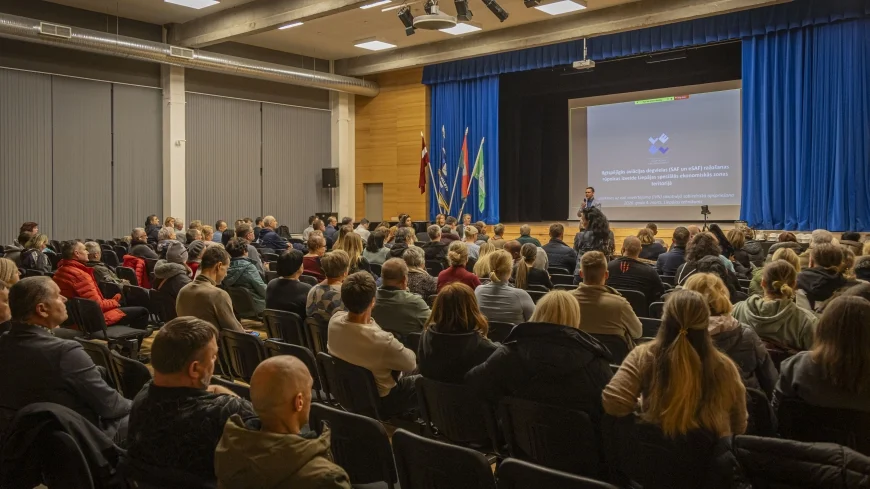
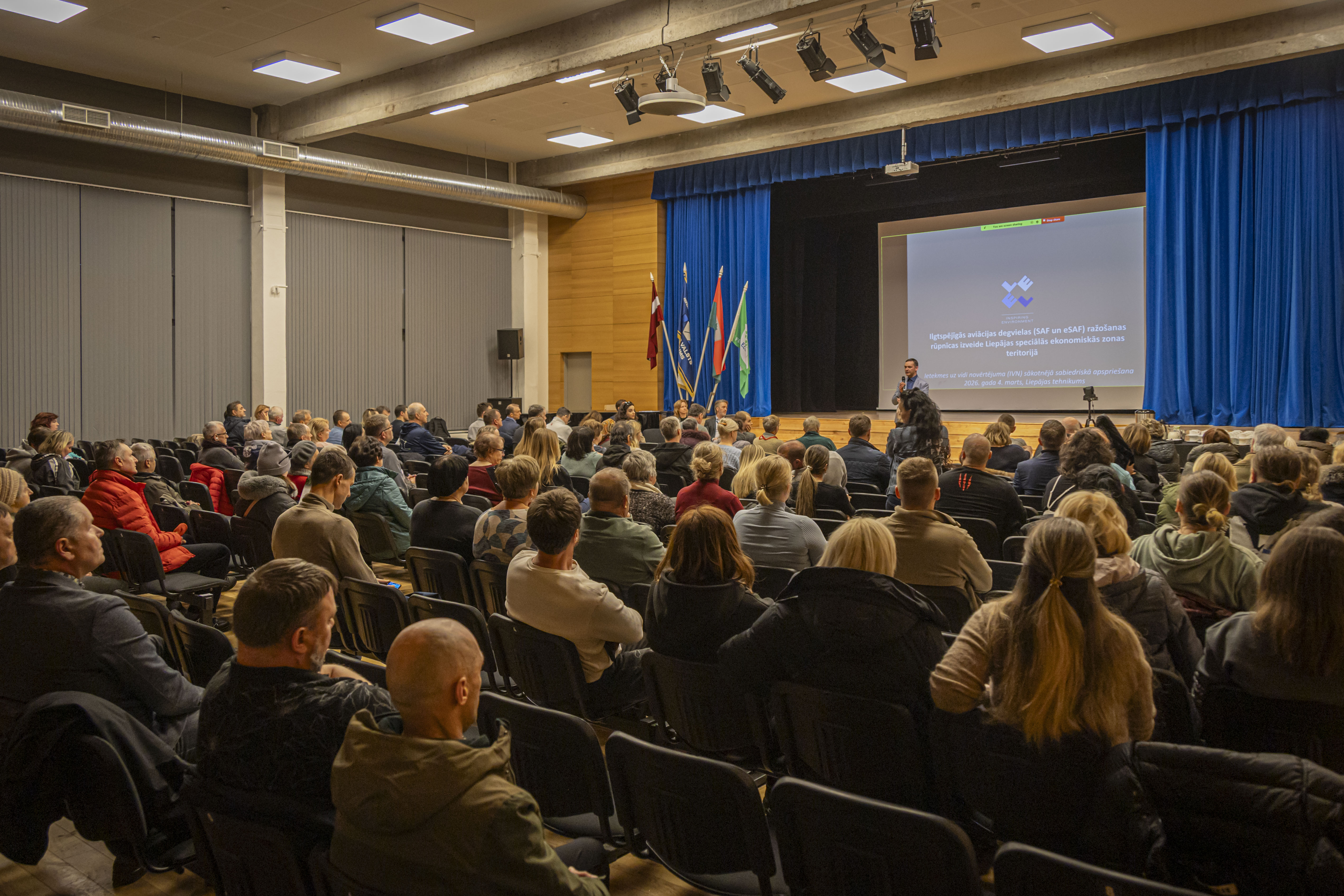
In the evening of March 4, an initial public meeting on the Environmental Impact Assessment (EIA) for the proposed “NorSAF” sustainable aviation fuel production project took place, featuring extensive explanations and discussions. The purpose of the meeting was to inform residents about the planned project and introduce the measures that will be carried out as part of the EIA procedure. A total of 162 residents attended the meeting in person, while 51 joined remotely via the Zoom platform. The meeting was held at the premises of the Liepaja State Technical School.
For the “NorSAF” sustainable aviation fuel (SAF) production project to move forward, an EIA procedure must be carried out. In accordance with the program issued by the State Environmental Service, the planned technologies and production processes will be studied in detail, with particular focus on their potential impact on people and the environment.
EIA Procedure Timeline
- On January 14, 2026, the State Environmental Service decided to initiate the EIA procedure.
- On February 20, 2026, the initial public consultation was announced through a publication in a newspaper. Informational letters were sent to residents whose properties are located adjacent to the planned plant site.
- On March 4, 2026, the public consultation meeting took place.
- Until March 12, 2026, residents as well as national and municipal institutions are invited to submit their proposals for the Environmental Impact Assessment program to the State Environmental Service via email at pasts@vvd.gov.lv or by mail to Rūpniecības Street 23, Riga, LV-1045.
- Within one month, the State Environmental Service will prepare the EIA program based on the submitted application and the results of the initial public consultation.
- Industry experts will then evaluate the technologies, environmental impacts, and safety issues in accordance with the program, and prepare the EIA report.
- In the second half of 2026, the completed report will be presented for public consultation.
- The EIA procedure will conclude with an official opinion issued by the State Environmental Service regarding the planned plant’s impact on people and the environment.
The Liepaja Special Economic Zone company NorSAF is advancing a sustainable aviation fuel (SAF) development project. The project plays a strategically important role in reducing CO₂ emissions in European aviation and aims to contribute to achieving the European Union’s sustainability and climate neutrality goals.
NorSAF aims to establish a modern, safe, and environmentally responsible production facility that operates in compliance with European Union environmental requirements and international safety standards. The project plans to support the aviation sector’s transition to lower-emission solutions. More information: www.norsaf.com/lv
About Technology
The project is based on the licensed PureSAF® technology developed by the U.S. company KBR - a globally unique Alcohol-to-Jet (ATJ-SKA) solution. The technology was developed in collaboration with Swedish Biofuels, a company that has been developing innovative sustainable aviation fuel solutions for more than 20 years. PureSAF® has been tested for several years by the Swedish Armed Forces, the US Defense Advanced Research Projects Agency (DARPA), the U.S. Army, Lufthansa, and various technology commercialization institutions. A small pilot plant has been operating for several years in Sweden on the campus of the Royal Institute of Technology in Stockholm with funding from the European Commission.
The scaling and engineering development of technology is provided by KBR, one of the world’s leading engineering companies with more than 100 years of experience in implementing industrial projects in the energy, chemicals, infrastructure, and defense sectors. For the past 60 years, KBR has also supplied technologies and engineering solutions for NASA space programs, demonstrating the highest standards of quality, safety, and innovation on a global scale. More information: www.kbr.com/en
What Does This Project Mean for Liepaja and the Region?
- Around 200 new high value-added jobs in engineering, chemistry, energy, and logistics, plus approximately 200 additional jobs during the construction phase.
- Development of local and regional business activity, including the hospitality and leisure sectors.
- Long-term tax revenues for municipal and national budgets.
- Strengthening Liepaja’s position as a climate-neutral city and a major industrial innovation hub in the Baltic region.
- A contribution to Latvia’s energy independence and security.
This is a strategically important national-level project for energy security and economic growth. It has already received Green Corridor status, aligns with the national development strategy RIS3, contributes to achieving climate goals, strengthens the regional economy, and positions Liepaja as a future center for green energy and aviation fuel in Northern Europe.
Additional questions can be sent to: jautajumi@norsaf.com